
A no-contact tracker answers “How long has it been?” A journal can hold “What was difficult today?” Using both gives you a record of time and a place for the experience inside it.
Neither can predict when you will stop missing someone. Day 30 is a date, not a promise about how you should feel.
Decide what you are counting
Before choosing a start date, write a sentence that describes your boundary. Be specific about whether you mean avoiding personal messages, stopping attempts to restart the relationship, or something else.
Necessary contact about shared responsibilities may still exist. If you co-parent or coordinate housing, define the practical communication you intend to keep. A day counter cannot make those decisions for you.
Avoid adopting a rule because a particular number is popular. The useful question is whether the boundary supports the life you are trying to live now.
Pair the number with three lines
You do not need a long entry every day. Try this small record when you want one:
- “The moment I most wanted to reach out was…”
- “What I did next was…”
- “What might make tomorrow easier is…”
An example might be: “I wanted to send the song we used to play. I saved the thought in my letter instead. Tomorrow I will put on a different playlist for the commute.”
That entry preserves a choice you made. It does not require you to claim that the feeling disappeared.
Look beyond the streak
At the end of a week, ask what has become more manageable and what still needs help. Perhaps you are checking your phone less during dinner. Perhaps evenings are still difficult. Both observations are useful.
If tracking makes you check the app constantly or compare yourself with other people, you can stop using the number. A boundary can exist without a visible streak. A journal can also be occasional rather than daily.
How it works in Rescript
In the current Letters flow, you can choose a no-contact start date inside a breakup letter. The date and count appear there and on The Desk. This keeps the context close to the counter: who you are writing to, what is unfinished, and why you are choosing some distance.
Letters remain unsent. The counter does not contact or monitor the other person, and it does not measure their activity. Platform releases may differ; consult the FAQ for the product overview.
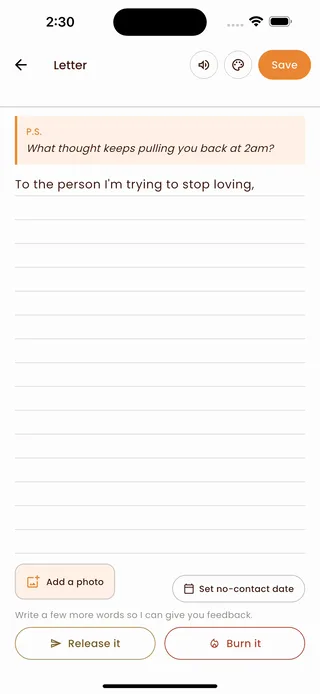
The no-contact date is set from the breakup letter.
A prompt for a difficult milestone
“Today the number is __. What that number does not show is __. One choice I want to recognize is __.”
You do not have to feel proud on demand. Naming the effort is enough. Continue with the breakup guide if you need a starting point for the letter itself.